How to Choose the Best Art for Your Home

Choosing the best art for your home is one of the most personal decisions you can make in a space. Unlike furniture or paint colours, art isn't just functional – it sets the emotional tone of a room and says something about who you are and what you value.
It can feel like a lot of pressure to get it right! But if you start with a few key principles – feeling, colour, scale – the rest becomes much more intuitive, and a really enjoyable process. Here are some expert tips on how to effortlessly curate meaningful art in your home.
1. Start with the Feeling You Want to Create
Before you think about walls or measurements, ask yourself: how do I want to feel in this room?
Different rooms call for different things. A bedroom generally benefits from something that helps you decompress – softer tones, a sense of space – imagery that isn’t too busy. A living room can carry something bolder, with more presence and energy. A hallway, often overlooked, is actually the first thing you and your guests experience, so it is worth treating it as an opportunity rather than an afterthought.
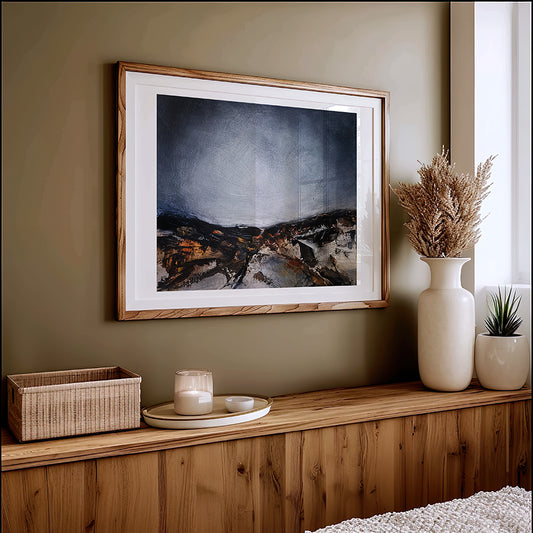
Think of each room as having its own emotional register, and let that guide your choices. A painting with an expansive horizon can make a modest room feel larger. Deep, earthy tones can make a large space feel more grounded and intimate. Art with vibrancy and colour can transform a north-facing room that never quite catches the light. In a room such as a bedroom, where you most likely want to feel calm, tranquil and at ease, opt for soft tones and fluid forms rather than dark, overly-contrasting angular and sharp shapes.
Rather than treating art as the finishing touch – something added once everything else is in place – consider it the anchor. Everything else can work around it. Simple things like finding cushions that complement the artwork tie everything together, particularly in a neutral interior, like the coastal beach home below.

2. Working with Colour
Colour is the most immediate thing art communicates, and getting it right makes a significant difference to how a room feels.
If your interior is largely neutral – creams, whites, warm greys – you have real freedom. Art with strong colours will hold its own without competing with anything. A piece rich in ochre, deep green, or the blue-grey of a winter coast can become the single element that gives the whole room life.
If your space already has colour in its soft furnishings, walls, or furniture, look for art that draws from those existing tones rather than clashing with them. This doesn't mean everything has to match – it means the art should feel like it belongs to the same conversation.
A practical approach: rather than matching your art to the walls, match it to the element of the room you love most. A painting that picks up the rust in a favourite throw, or echoes the colours of the garden or beach beyond the window, will feel far more considered than one chosen simply because it blends with the walls.
As a general principle, warm tones – terracotta, amber, blush – create a sense of energy and connection. Cooler tones – slate, sage, pale blue – bring calm and space. Knowing how you want the emotional temperature of a room to feel is the quickest route to knowing what colour art you could consider.

3. Scale and Proportion
Scale is where most people hesitate and where the most common mistakes are made, usually in the direction of going too small.
Small art works hung on a large wall looks ill-considered, like it hasn't committed to being there. As a reliable guide, aim for a piece that fills around half to two-thirds of the wall space it occupies. Above a sofa, that means the artwork should span roughly two-thirds of the sofa's width - which is often larger than people initially reach for. Trust that proportion. A well-scaled piece gives a room the focal point it needs.
Before buying, test the size. Cut newspaper or paper to the dimensions you're considering and tape it to the wall. Stand back and look at it properly. It's a simple step that removes a lot of uncertainty. If you are in love with an original painting but it seems too small for a space, look into whether there are fine art prints available in a larger size of the same painting. Many of my originals are available in larger sizes as prints so they become more versatile.
For hanging height, the centre of the piece should sit at roughly eye level – around 145-150cm from the floor. When hanging art above furniture, bring it down so there's a comfortable relationship between the two; a gap of around 15-20cm usually works well.
Alternatively you could consider grouping a selection of smaller paintings together – just ensuring that they look harmonious when arranged alongside each other.
If you're grouping smaller works, treat the whole arrangement as a single piece when thinking about scale. Lay everything out on the floor first, find a configuration that works, then transfer it to the wall.
4. Choose What You Actually Love
It sounds obvious, but it's worth saying: the art that lasts in a home is the art that genuinely moved you when you first saw it – not the piece that seemed safe, or that someone else said worked well in that kind of space.
Safe, mass-produced art tends to not really be seen. The pieces you return to over years, the ones that you just want to spend time with and gaze at, are almost always the ones that stopped you in your tracks in the first place.
Art becomes your daily companion. You'll live with it through different moods and different seasons. It's worth choosing something that rewards that kind of ongoing attention.
My own work is rooted in wild, elemental landscapes – the particular light of a Cornish moor, the ever shifting nature of open water, the way a coastline holds both stillness and energy at once. For those of you drawn to nature and the natural world, who want to bring a sense of the outdoors into your living space, I hope you'll find something here that feels right for you.
5. Commission an artwork
Not many people think that commissioning an artwork is available to them, but it can be a wonderful way to work closely with a favourite artist (like me!). If you like the style of an artist, but need something in a particular size and would like a particular kind of feel or palette, this could be an interesting and exciting option.
*Browse the collections organised by mood and feeling, to make the choosing a little easier.*