In Conversation with Paul Lewin

Did you have any artistic influences as you were growing up?
My parents encouraged me to draw and paint. My dad was a textile designer; my mum was a teacher and is very good at drawing. Some parents might have said: ‘don’t try and be an artist, there’s no money in it’ and they would be correct! But I think they saw that art was the subject that I shone at and they never put up any barrier to me in following that as a vocation.
After my A levels, I did a Foundation course in Stockport near where we lived. One of my tutors saw that my strength was in drawing and observation, and he suggested I try Bristol as it was based in traditional practices. I loved it. They taught us everything from colour theory to how to stretch a canvas and you could try everything from painting and printmaking to sculpture. They had excellent visiting tutors such as Paula Rego, as well as tutors from the Slade to teach very regimented observational drawings, which, although a bit boring at the time, was a good foundation for my later work.
When did Cornwall come into focus for you?
On the second year of my degree we had a week-long field trip to West Cornwall. I was immediately blown away by the landscape. I remember standing on the cliffs at Botallack – I had just never seen anything so powerful. It was my first serious experience of working outside and I did loads of drawing. I don’t think I realised at the time, but that was when I found my subject.
The drawings I created in that week ended up being some of the best from my whole three years at Bristol. The challenge of fighting against the wind and weather was so exciting and I became completely absorbed in what I was doing. So much so that when we were offered a private visit to spend half a day with Patrick Heron at his studio I chose to stay outside and keep drawing! Looking back, it was silly to miss an opportunity like that, but I guess it showed how inspired I felt.
Was becoming a full-time artist a conscious decision?
I think it’s only in reflection that you can pinpoint certain choices as being pivotal in your career. I finished my degree, feeling slightly lost. I remembered that week spent in West Cornwall and decided to go back for three months. Once again I was blown away by the power of the landscape and the weather, walking the coast all the time, drawing in charcoal. Like many who visit Cornwall, I didn’t leave!
Eventually I needed to sell something. So I gathered together some drawings and wandered into the New Craftsman. It was showing Peter Lanyon’s work and was the best gallery in St Ives at the time. I just walked in with my portfolio! They told me to frame up four paintings and they started selling. Other galleries became interested and solo shows followed. In about three or four years I was making a living from my art.

When did colour come in?
After about six months of charcoal drawings I started experimenting with a bit of colour with pastels and watercolours, but I wasn’t pleased with the results. The colour palette of Cornwall is quite particular and I couldn’t get it right – being from Manchester and then spending time in Bristol, well, there’s no sea! So trying to replicate the extraordinary colours of the ocean took some time.
I think the drawing was more important anyway, particularly when you’re trying to capture the structure of the cliffs and paint them convincingly. That’s the starting point really.
How do you work with the constantly-changing weather and light of Cornwall when you’re painting on location?
I always finish a painting on location on the same day. When I’m painting outside I get drawn into a deep space of intense concentration and I just need to finish it. The weather and light would be completely different if I returned on another day. Sometimes it’s hard to finish a painting completely so I may take it back into the studio.
These large oils I create completely in the studio. But I can only do that because I have spent so much time painting and drawing outside. I couldn’t do anything in the studio for the first ten years in Cornwall. Every time I tried it failed, because I didn’t have the visual memory or experience to pull it off. For me it’s about getting outside capturing the spirit of a place.
Do you have a particular process when going on location to paint?
My bag is always packed and ready by the door, ready to go. I’m very familiar and comfortable with my equipment so it feels very natural. The location I have in mind will depend on weather, time of year and wind direction, amongst other things. It’s this idea of a location that gets me out the door – but I often get distracted and end up somewhere else. And I’m open to that. You have to be open for chances of light – in a moment the sun can bring a scene to life and you just have to be there in the moment to experience that.
Then it’s basically just getting rid of the white paper and everything else comes from that. One mark leads to another, so your first mark will dictate the rest of the painting. I don’t like to say that to my students though because it makes them too self conscious!
How do you approach a painting or drawing when it doesn’t seem to be working?
A successful painting is never a given – there’s no certainty it’s going to work. A lot of my work is about dealing with mistakes, and pushing through mistakes. Over the years I’ve pushed paintings to the extreme, so I know what can and can’t be done, and I’ve had lots of failures on the way, not every painting has been a success.
You’re a tutor at Newlyn School of Art. What is a key piece of advice you give your students?
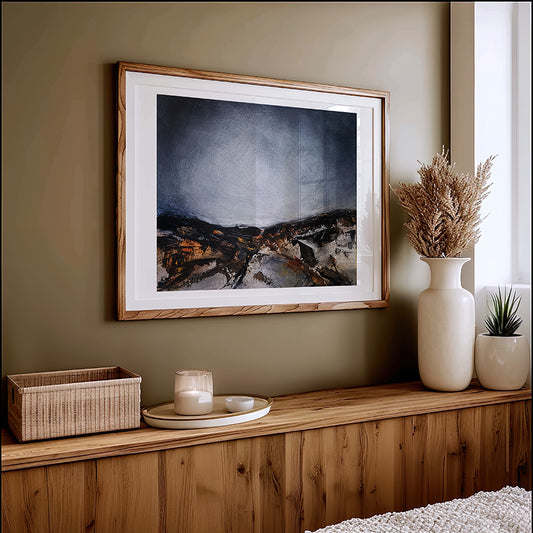
You can’t be too precious. That’s the way my technique has developed. If you look closely at my paintings you’ll see that it’s just thrown paint and brushstrokes - almost abstract up close. There’s lots of changing of my mind and scraping back involved. But that in itself reflects nature. Nature isn’t perfect; it has all sorts of anomalies. The technique I use, which includes throwing paint, encourages randomness and chance to some degree and that helps to keep the paintings alive, and helps to keep me interested.
Do you go out in all weather? If it’s blowing a hoolie and there’s horizontal rain do you think: ‘It’ll be a studio day then’?
Ha! I do make the effort to get out. There’s an edge to a painting done in stormy weather like that. It’s usually unfinished, but it is perfect in its own way. It’s the imperfections, the struggle, that is part of it.
There are some hilarious clips of me online that were filmed for The One Show. The BBC had been looking for an artist that was mad enough to paint in a storm, and they contacted me through Henry, who runs the Art School.
I arranged to meet them at Pendeen by the lighthouse and got there early to get some paint down before they came to film. It was an incredible day with bright sunshine and a wild sea, but I really struggled to find a spot where I wouldn’t get blown away! As the film crew arrived I could see this dark cloud coming in. Just as they started to interview me it started hailing. Force 8 hailstone were bouncing off my painting and hitting my face, it really hurt! I’m making up stuff because I can’t hear what the interviewer is saying, and I’m grinning because it seemed so ridiculous. The painting actually turned out really well though and I ended up getting something like twenty-five-thousand hits on my website the day it aired.
Is there something that you particularly want to transmit through your paintings?
I suppose if there’s anything, it’s a sense of awe and wonder. It’s so easy in modern life to become numb, and I think it’s really important to spend time in wild places because they enrich you. There’s an Irish term for a place that’s close to heaven: a ‘thin’ place – where your connection to the spirits is very close. They’re the places I like. They almost make my spine tingle with how extraordinary they are and how small we human beings are in comparison. So there’s no big concept with my work, it’s the rawness of nature that really interests me, that and simply connecting to the landscape and the ocean.
'Penhale Point' Watercolour collage - Copyright Paul Lewin (used with permission from the artist).
Interview originally for Newlyn School of Art.
Paul Lewin https://www.paullewin.co.uk/