In Conversation with Jessica Cooper

How would you describe your current work?
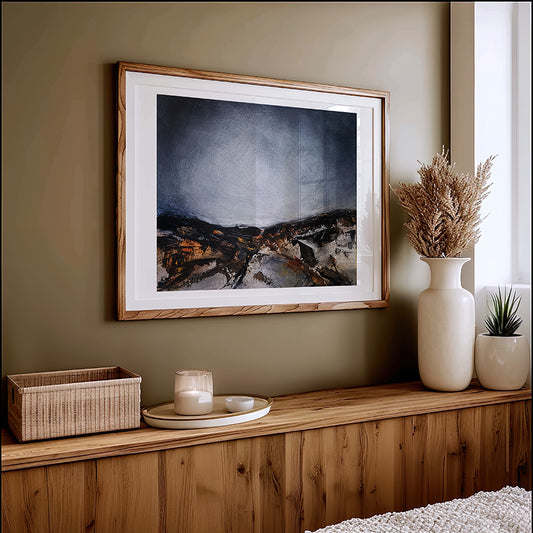
My work is very much about the essence and core of things, it is about minimalism and paring down, about seeing familiar, domestic things in a different way – appreciating the overlooked and the unseen. I look at the different components of composition and space and how they work together, and I am always looking to create a sense of honesty and truth in my work.
Does living in Cornwall have an influence on what you create?
West Penwith is quite a harsh environment to live and work in, whatever profession you’re in. You have to have a conviction, a belief in what you’re doing if you want to make your mark. But on the other hand you have the peace and the quiet, and few distractions. For me, it is where I find a sense of stillness, which allows me to create.
Like Mark Jenkin [a Filmmaker who has a nearby studio] I was brought up down here before Cornwall became popular, and I think a lot of his work, like mine, evokes the rawness and realities of surviving as artists in West Penwith. Even though my work can be quite positive, it’s often also about isolation and hardship.
For me, the weather here informs what I create too. I get through the winters by working. I can come up to the studio and it’s my safe ship in a tumultuous sea!
Where did your interest in art come from?
Neither of my parents were artists as such, although they were interested in the arts. My father was a talented musician, with a passion for gardening. He created the most amazing garden at our home. His love for nature, form and colour had a big impact on my work. My mum was a gifted seamstress and made all our clothes as children, later, she did life drawing too.
My parents were quite bohemian. They had travelled and lived abroad before they settled in West Penwith. They loved the area and soon became part of an artistic community. A good friend of my mum was a nurse to the artist Roger Hilton, who lived up the road, and they were friends with Charles Breaker, who made incredible knitwear pieces, and Stella Maris, a brilliant weaver. So as I was growing up I was surrounded with artistic people.
As a young child I was always drawing. We didn’t have a phone until I was about three; a TV until I was six. If I was bored I was given pens and paper. I loved painting and creating. At home, we had two massive plate glass windows – one looked over the moor and my dad’s garden, and the other framed the cliffs and the sea. So from an early age I had an incredible visual palette to draw on. Now I look back, I realise that those two elements still consistently inform my work.

How did studying both textiles and fine art at Goldsmiths influence your development as an artist?
I always had a love of fashion, fabric and design, so I was torn between studying textiles and fashion or pure painting. Goldsmiths offered a course in both, so it seemed an obvious choice. After a year there I wished I had chosen to do pure fine art. I just wanted to paint.
I found it really tough at the time, but in hindsight, I’m so glad I stuck at it because during that first year we had a whole term of weaving, then embroidery, then printmaking. Learning those skills was invaluable. I still find my work crosses the line between being quite graphic and more painterly.
How did you get involved with Newlyn School of Art?
I first came to the School when a friend gifted me a one-day print course here. Henry [Garfit] introduced himself and showed me around the building. I love the fact that this was a school and now still is a working school. It has that lovely feel of being used, that it’s carrying on that tradition. You can even still see the old hopscotch marks peeking through the moss in the playground out the back. It is like an oasis at the top of the hill.
Later, Henry asked me if I’d like to teach. I used to teach at the Tate and the Newlyn Art Gallery, amongst other places, but had given up teaching to concentrate on my own work. I always joke Henry got me out of retirement! But for me it was an easy decision – I absolutely love the ethos of the Newlyn School of Art and the programme, and it runs beautifully alongside my own practice, which I think is quite rare and a real gift.
Can you share a little of your process? How do you begin your creative day?
I put on music, put the kettle on and walk around my space before I do anything. I’m like a cat, prowling around, taking my time and quietly observing things.
If I’m not in the mood to paint I’ll do practical stuff such as attaching canvasses to frames and sorting out my paints. I know my practice and myself so well now. In the past I thought I had to paint all the time, but now I may just come in and sweep the leaves up outside. Some days I come in and I know exactly what I’m going to do and can’t wait to get painting. It’s very much about being in this space for the first hour before getting started.
I’m a huge advocate of the immediate mark, of spontaneity, but that only comes from really thinking about a painting. So I can have maybe four weeks where I’m really thinking about a piece of work and what I want to do, before I can come into the studio and create it. When it all goes well, I can create a piece of artwork in four hours.
Whatever happens, at the end of each day I leave the studio completely clean, so that the following morning it’s like walking into a blank canvas.

Has your work changed noticeably during your career as a professional artist?
There’s always been an element in my work of trying to find simplicity in the chaos, about the power of the line and space, but for the first few years it was very much all about colour.
Then someone did a review of my work and compared my use of colour to Matisse, and I just thought, ‘I’m never going to use colour again!’ I had to prove to myself that I was a painter without having to use colour in my work. So the colour became really pared down, and the subject matter became more and more minimal.
Years later I was living between Los Angeles and Cornwall. I was literally caught between two places. I was influenced both by LA with its post-modern architecture, urban square buildings and palm trees popping up everywhere, and by the poverty and non-glitz of Cornwall.
Then the pandemic came with all its challenges. This studio was my sanctuary. Lots of artists began painting flowers as we were all so confined, but for me painting flowers took me right back to my childhood and all the drawings of my dad’s garden. That simplicity of line, the essence of form, is a subject that I need and want to keep coming back to.
If I’ve learned anything about myself in the last two years it is that actually I love painting. And I just simply want to paint.
Interview originally for the Newlyn School of Art
All images and text by Kari Herbert
Jessica Cooper https://jessicacooper.co.uk/