In Conversation with Imogen Bone

Can you tell us how you structure your practice?
I come into the studio most days, but I also do ‘research trips’, which is basically a nice walk and a bit of sketching! Sometimes I don’t even sketch. It’s essential to know your subject, and you're probably taking in more if you're just walking and really observing.
I find that if you spend all your time sketching, you end up just looking at your own hand in a sketchbook; you're not necessarily really taking in the full experience. Of course it is important to sketch, but I wouldn't say that’s the only thing to be done outside.
Sometimes I make notes of the wind direction, where the light source is and what the sounds are. There are certain places which I associated with different sounds; like when you’re on the North Cliffs it is all about the skylarks, it’s lovely.
Do you ever finish work outdoors?
I will sometimes do a few thumbnails, working out different compositions, or I just map down a few of the colours of a place. Occasionally I might do a very simple watercolour, taking things a little bit further.
These things then creep in to some of the paintings back in the studio – maybe with a different movement of the brush or a kind of fluidity of the drawing. If I’m trying to capture the wind direction, for instance, my hands and brushstrokes will move in the same direction as the wind, the movement of the light and the clouds. All these things speak to that moment.
I don't do any big work outdoors. The work I do outside is always a starting point for me, not a finishing point. The finishing point is all about bringing in those extra memories; thinking about what the place felt like, and what you’re trying to convey of the place. I can only do that in the studio where I can really focus and get absorbed in the painting without any distractions.
Do you work purely from your sketches when you’re back in the studio?
I take loads of photos as well when I’m working outside. They are an excellent resource. They’re useful as a creative trigger and are helpful when you need some accuracy in a painting. I can't always rely solely on my sketches because even though I may have sketched the same place three times, the rocks are likely to be slightly different shapes in all three of them! So if I need to capture a specific, recognisable location, I may refer to photographs too. As for the atmosphere of a place, that is down to memory and the quality of my sketches.
Always, my sketching outdoors is an immediate response to a place; a way of getting the most important bits of information down. Then the painting back inside the studio is more of a reflection of the time spent there and what it is I’m trying to convey in that painting – why that place or that view interested me in the first place.

Where did you study art?
I studied illustration at Falmouth School of Art. I was taught from the beginning that you had to treat your creative work as you would a job. It was a great lesson in discipline: you had a set timeline, and you just got your work done. You had to be practical and had to use your time wisely.
We didn’t have all this self-reflection that the fine art students had; for us, creativity didn’t always have to be about emotion and deep thoughts – I just don't have many deep thoughts anyway! Sometimes as an artist you’re expected to make up some kind of intellectual angle for your work or talk about some kind of angst you’re having. That’s just not me.
When I left Falmouth, I couldn’t afford to buy a computer, which you needed to be a successful illustrator. I could, however, afford some paint and canvas, so that’s when I started painting. At first I did quite abstract work. I have done some figurative work, but it’s not my comfortable place. I always come back to the landscape.
It’s taken me a long time just to accept that it is fine for you to paint the thing because it looks nice. And it’s okay for other people to like things which just look nice. The landscape is so lovely here in Cornwall. Why not just represent it as it is? It doesn't all need to be interpreted or changed or altered.
You’re a tutor at Newlyn School of Art. How did you get involved with the school?
Henry [Garfit] just phoned me up one day and asked if I’d like to do some teaching. I had done a little bit of teaching from my studio years before – people would come and paint with me for three hours, but that was about it, so it was a bit like being thrown in at the deep end. But I’m so glad I started teaching at Newlyn. I know people enjoy my courses and get something from them; it feels really worthwhile.
It’s given me a lot of confidence, too, because you have to articulate what you do, which you don't always do when you’re just working on your own. Now whenever I get stuck, I think: ‘What would I tell my students in this situation?’ That often helps me get back on track.
The art school has got such a good reputation, but the main thing for me is that it just has such a nice vibe. There’s so much enthusiasm from the team and the students, and as tutors we’re given the freedom to teach the way we want to. It’s been amazing to be affiliated with them.
You lead short courses in Tresco as well as in Newlyn. Do you find it very different being in the Scillies than being in Cornwall?
Going to Tresco is like going home for me, really. After doing my degree at Falmouth I went travelling, then met a girl who was from Scilly who invited me to stay with her for the Tresco gig championships. I went for the weekend, got a job and ended up staying in Scilly for ten years! It was perfect because I kind of lived this eternal summer for a few years where I'd be in Scilly for the summer, save up all my money, then go off travelling for four months in the winter.
A friend’s mum in Scilly knew I liked painting. She had a glassworks studio with newly-built studios at the back. One year she said I could take one of the studios. It was a fantastic opportunity. My studio was open to the public – people could just come in and buy directly from me. Because I was there all the time, I was able to build up a nice rapport with customers who came back year after year. Some of those customers have been collecting my work for fifteen years now! It’s really nice. They've seen my work change and evolve and improve.
My work was featured in a show of local artists at Gallery Tresco. They sold everything I had! I still work with Anna, the owner, plus a few other amazing galleries across Cornwall. So Scilly is where it all started really, and will always be a special place for me.
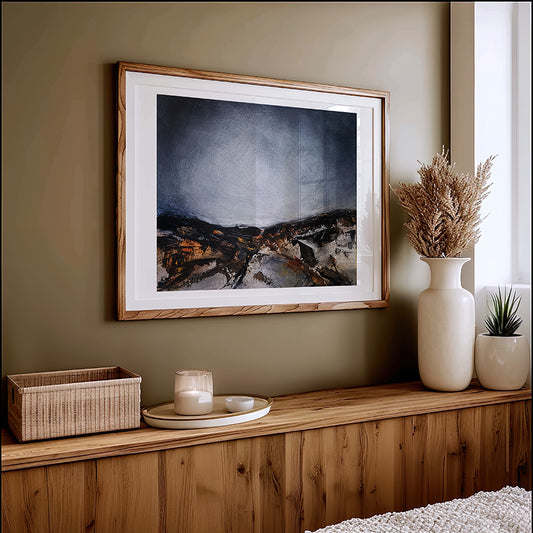
 Coastal study Copyright Imogen Bone, used with permission by the artist
What’s the one bit of advice that’s kept you going in your art career so far?
‘Just do something’. That's what my friend’s mum taught me. She would say it doesn't matter if you don't fancy painting that day or whatever, just do something: prime a canvas, send an email, whatever; just do something so you’re always moving forward. I stick to that advice every day.
Imogen's work is available at:
The Byre Gallery https://thebyregallery.co.uk/collections/imogen-bone
Summerhouse Gallery https://www.summerhousegallery.co.uk/imogen-bone
Padstowe Gallery https://padstowgallery.co.uk/collections/imogen-bone
Tamarisk, Scilly https://tamariskscilly.co.uk/collections/imogen-bone