Abstract vs Realistic Landscape Art: What's the Difference?

Abstract vs Realistic Landscape Art: What's the Difference?
If you've been thinking about buying landscape art for your home, you've no doubt debated between two particular styles: realistic, or abstract. It sounds like a simple choice. But it isn't, really, particularly as there is a lot of art that falls somewhere between the two – but understanding where each approach comes from can be really useful in gauging what is most appropriate for you and will likely save you from buying something that looks great in a gallery but never quite feels right in your own home.

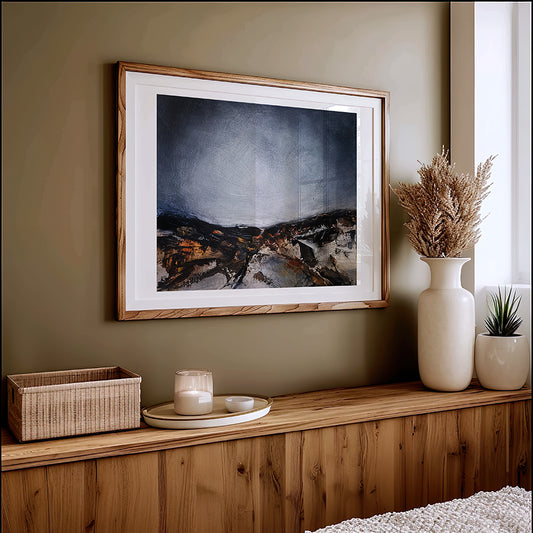
Above: 'Listen, the Land is Calling' - expressive landscape fine art print by Kari Herbert
What realistic landscape art is doing
A realistic landscape painting is trying to show you a place. The artist has looked at a headland, a field, a stretch of coast, and worked to represent it accurately enough that you'd recognise it if you stood there yourself. The skill lies in observation - getting the light right, the proportions right or describing the particular way a cliff meets the sea. It's a record of a particular place and a moment in time, and is a beautiful one when done well.
What expressive, abstract landscape art is doing
Abstract landscape art isn't trying to depict a specific place. It's trying to give you the feeling or the emotional quality of being in nature. When I start a painting, I'm not working from a photograph or trying to reproduce a specific view necessarily. I'm responding to what it felt like to experience the weather or light, the thrum of the land or the mood of the sea. It might be a response to the colours that caught my eye that day – the subtle greys of an overcast sky in February, golden gorse and purple heather on a moorland or vibrant cliff-loving wild flowers, or the rich russet tones of bracken as summer turns to autumn.
The colour, the mark-making, the layering of cold wax and pigment — all of it is in service of that felt sense, not a literal likeness.
This is why two people can stand in front of the same abstract landscape and see two different places. One person sees the moor after rain. Another is reminded of a coastline they visited once and can't name. Both are right, because the painting was never pinned to a single, correct answer.
The practical difference for your home
This distinction matters more than it sounds like it should, because it changes how a painting behaves on your wall over time.
A realistic painting tends to stay exactly what it is. You'll always see the same headland. That's a strength if you want art that's unambiguously about somewhere — a family holiday spot, a place with personal history attached. And that is wonderful, evocative and meaningful.
An expressive abstract landscape can shift. It reads differently depending on the light in the room, your mood that day, how long you've lived with it. People who own my work often tell me they notice something new in a piece months after buying it - a subtle nuance in the layering of paint; a colour relationship they hadn't appreciated before. That's not accidental. It's what abstraction is for: it gives you room to keep finding things, rather than handing you the whole picture on day one.
Which one is right for you?
Neither is objectively better – it depends on what you want a piece of art to do in your home.
Choose realistic landscape art if you want:
- A specific, recognisable place captured accurately
- Art that has a strong connection to a particular location or memory
Choose expressive abstract landscape art if you want:
- Something that evokes a feeling or atmosphere rather than a scene
- A piece that can keep revealing itself over time
- Colour and texture that work as a focal point in the room, not simply a window onto somewhere else
At the end of the day, the best piece of art for you is the kind that pulls you in and keeps you curious. The kind of art that makes you wonder how you ever lived without it! It becomes a companion, a valuable part of your home.
Where abstraction and emotion meet
The best abstract or semi-abstract landscape art still has a sense of place in it, even if you can't name it. That's the thing I bring to my work – not accuracy as such, but a different kind of truth of place. It tells a story that is unique to every viewer. I want my work to echo the way that wild, elemental landscapes have a way of moving you, of making you feel something. An expressive, semi-abstract piece can hold that feeling long after the moment itself has passed.
If you're drawn to work that captures the spirit of wild landscapes or coastal places you can browse my collections by feeling by clicking on the Fine Art Prints in the menu – you'll find collections from earthy and grounded through to atmospheric and full of awe. Many started as a real place and a real moment in time, even if what's left on the canvas is something closer to a memory than a map. Some are an imagined evocations of place – a remembrance of the peace, connection and soul nourishment that wide open spaces can give you.